Solar Panels for Religious Places

Solar Panels for Religious Places

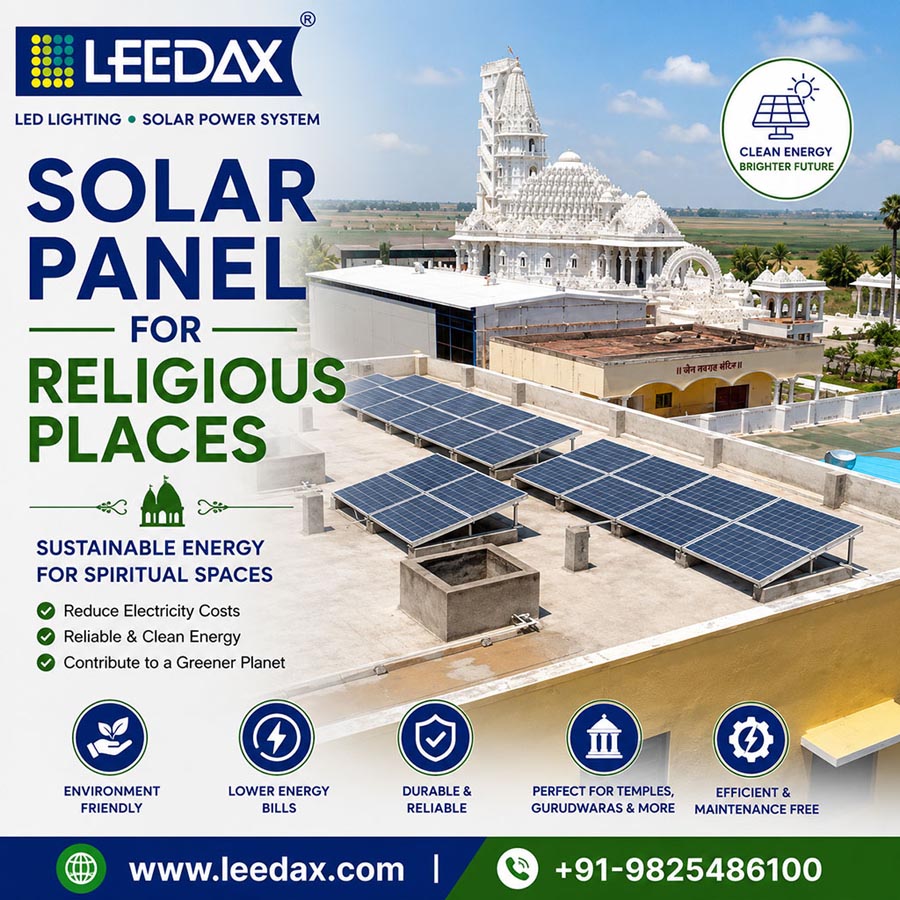
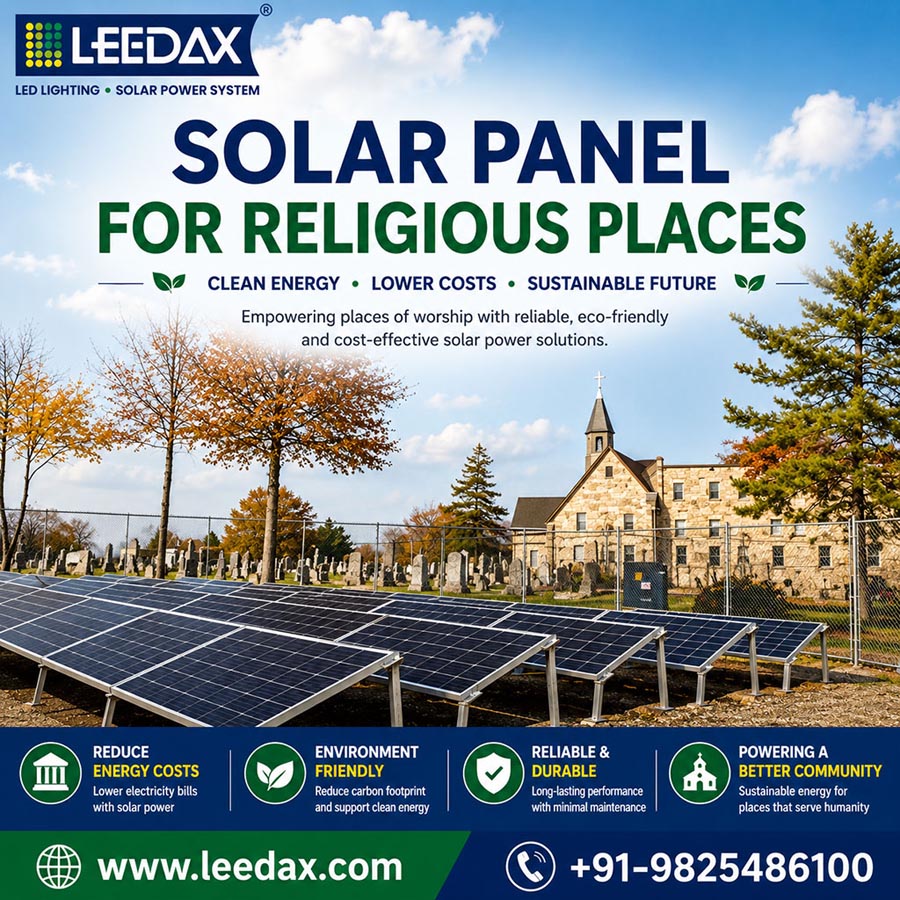
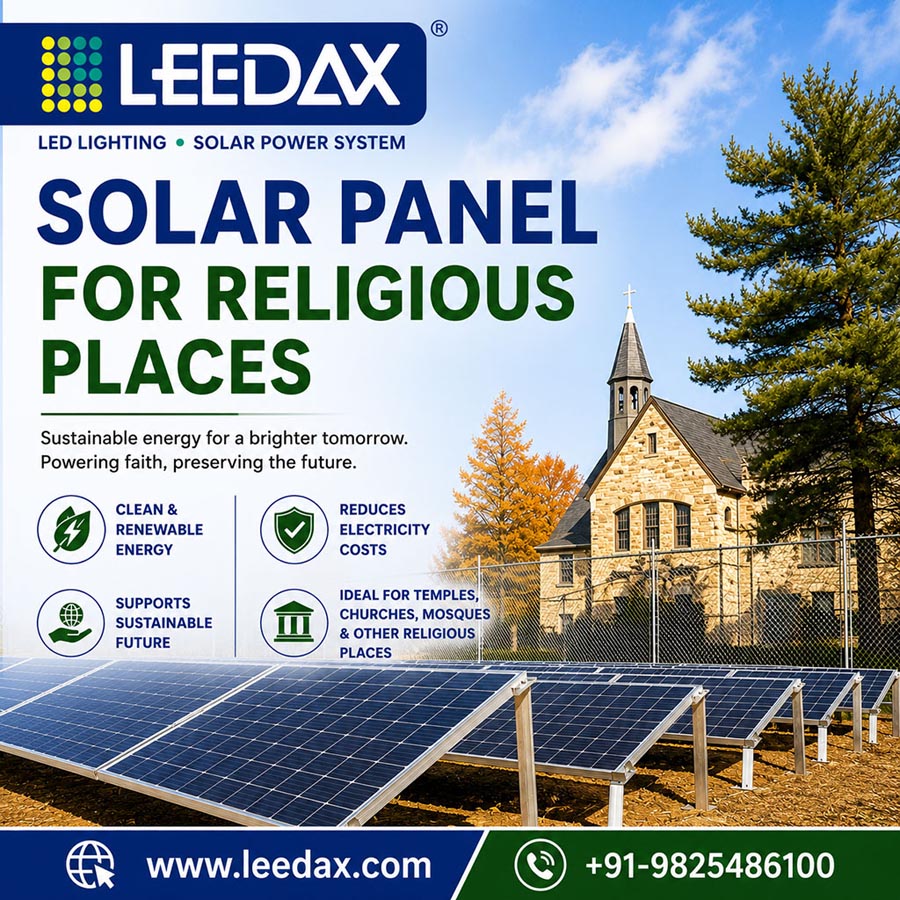
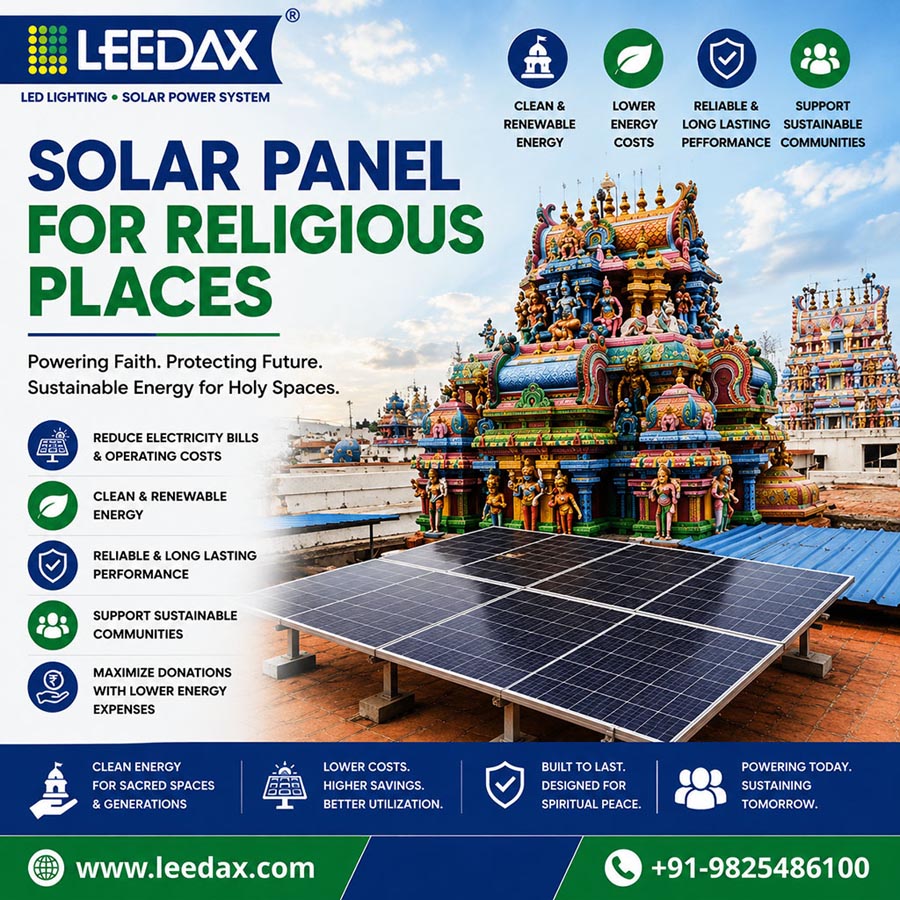
Religious places and spiritual institutions often operate large premises that require electricity for lighting, fans, air conditioning, water pumps, kitchens, community halls, accommodation facilities, security systems and other daily activities. Temples, mosques, churches, gurudwaras, monasteries, Jain temples, community prayer halls and other religious institutions can use solar panels for religious places to generate clean and renewable electricity while reducing their dependence on conventional grid power.

Many religious buildings have spacious rooftops, terraces, parking areas or other suitable spaces that can be utilized for solar installations. A professionally designed solar power system for religious places can convert these underutilized areas into productive energy-generating assets. Solar electricity generated during daylight hours can be used to meet a portion of the institution’s regular electricity requirements.

Solar energy can be particularly beneficial for religious institutions because many facilities have substantial daytime and evening electricity consumption. Lighting, ventilation, cooling, water pumping, kitchens and community activities can result in significant energy requirements. A suitably sized religious place solar rooftop system can help offset a portion of this electricity consumption.

Apart from potential electricity-cost savings, solar power supports environmental responsibility and the adoption of clean energy. Religious institutions can demonstrate their commitment to sustainable practices by utilizing renewable energy while maintaining their focus on community service and social responsibility.

LEEDAX provides customized solar EPC solutions for religious places, covering site assessment, system design, engineering, procurement, installation, commissioning and monitoring. Solar systems can be designed for small places of worship as well as large religious campuses with multiple buildings and facilities.

With appropriate system sizing, high-efficiency solar panels and professional installation, solar panels for religious places can become a long-term renewable-energy solution that supports both operational efficiency and sustainable infrastructure.


Solar System Type Grid-Connected / On-Grid Solar Power System
Solar Module Technology Mono Crystalline / High-Efficiency Solar Modules
Solar Module Capacity As per project design and available installation area
Solar Plant Capacity Customized according to electricity consumption
Solar Inverter String / Central Inverter as per project requirement
Installation Type RCC Rooftop / Metal Rooftop / Ground Mounted
Mounting Structure Hot-Dip Galvanized / Corrosion-Resistant Structure
DC Cabling UV-Resistant Solar DC Cable
AC Cabling Suitable Copper / Aluminium Power Cable
Electrical Protection ACDB, DCDB, SPD, MCB/MCCB and required protection
Earthing System & Equipment Earthing as per applicable standards
Lightning Protection Lightning Arrestor wherever required
Solar Monitoring Online Generation & Performance Monitoring
Metering Generation / Import-Export Metering as applicable
System Design Customized after Site Survey & Load Analysis
  • Solar panels for religious places can be customized according to the electricity consumption, available rooftop area and architectural characteristics of the religious premises. One of the key features of a solar system is its scalability, allowing it to be designed for small places of worship as well as large religious campuses with multiple buildings and facilities.
  • High-efficiency mono crystalline solar panels can maximize electricity generation from the available installation area. The system capacity can be determined after assessing the institution’s electricity bills, connected load, consumption pattern and available installation space.
  • Solar systems can be installed on suitable rooftops, terraces, parking structures or ground-mounted areas. For religious buildings with distinctive architectural structures, mounting arrangements can be planned carefully to maintain the aesthetics and functional requirements of the premises.
  • Modern solar inverters efficiently convert the DC electricity generated by solar modules into usable AC electricity. Solar monitoring systems can provide information about energy generation and system performance, helping the institution keep track of its renewable-energy production.
  • Electrical safety is another important feature. Proper DC and AC protection, surge protection, earthing, lightning protection, cable management and isolation arrangements can be incorporated according to the project design.
  • Solar electricity can support a wide range of loads, including lighting systems, fans, air conditioning, water pumps, kitchens, community halls, offices, accommodation facilities and other electrical equipment.
  • For larger religious campuses, the solar system can be integrated into a broader energy-efficiency strategy covering multiple buildings and facilities. LEEDAX can provide end-to-end solar EPC services for religious institutions, including site survey, engineering, procurement, installation, commissioning and performance monitoring.
  • Installing solar panels for religious places can provide several financial, environmental and operational benefits. One of the most important advantages is the potential reduction in conventional electricity consumption. Religious institutions can have significant electricity requirements for lighting, fans, air conditioning, water pumping, kitchens, community halls and other facilities. Solar generation can help offset a portion of this electricity requirement.
  • Solar power can also help religious institutions manage their long-term operating expenses. Electricity generated from sunlight can provide an alternative source of energy and reduce dependence on conventional grid electricity. This can support better energy-cost planning over the operating life of the solar installation.
  • Another advantage is the productive utilization of available rooftop space. Temples, mosques, churches, gurudwaras and other religious campuses often have large rooftops, terraces or suitable open areas. Installing a religious place solar rooftop system can transform these spaces into useful renewable-energy assets.
  • Solar energy also supports environmental sustainability. During operation, solar photovoltaic systems generate electricity without direct fuel combustion, helping reduce dependence on conventional energy sources. Religious institutions adopting renewable energy can demonstrate environmental responsibility and encourage communities to consider cleaner energy solutions.
  • For institutions serving large communities, solar installations can also create awareness about renewable energy and sustainable living. A visible solar project can become an example of responsible resource utilization.
  • Large religious campuses with kitchens, accommodation blocks, schools, hospitals, community halls and administrative buildings can potentially achieve greater energy benefits by developing a centralized solar power system based on their combined electricity consumption.
  • With proper engineering, quality components, suitable system sizing and regular monitoring, a solar power plant for religious places can become a valuable long-term energy asset.
  • Solar panels for religious places can be used across a wide range of religious and community-oriented facilities. Temples can utilize solar power for illumination, fans, air conditioning, water pumps, community kitchens, administrative offices and other electrical requirements. Large temple complexes can also evaluate rooftop or ground-mounted solar installations for multiple buildings.
  • Solar panels for mosques can support electricity requirements for lighting, fans, air conditioning, water pumping, administrative areas and community facilities. Similarly, solar panels for churches can be used for lighting, cooling, offices, halls, kitchens and other operational requirements.
  • Gurudwaras can use solar power for prayer halls, lighting, air conditioning, water pumping, community kitchens and accommodation facilities. The large electricity requirements of community kitchens and associated facilities can make renewable energy an important part of an overall energy-management strategy.
  • Solar energy can also be considered for Jain temples, monasteries, Buddhist centres, ashrams, spiritual centres and other religious institutions.
  • Large religious campuses may include multiple buildings such as prayer halls, accommodation facilities, schools, hospitals, kitchens, dining halls, offices, community centres and parking areas. A centralized solar power system for religious institutions can be evaluated based on the combined electricity consumption of these facilities.

Typical Applications Include:

  • Temples and Temple Complexes
  • Mosques and Islamic Religious Centres
  • Churches and Christian Religious Institutions
  • Gurudwaras
  • Jain Temples
  • Buddhist Monasteries and Centres
  • Ashrams and Spiritual Centres
  • Community Prayer Halls
  • Religious Schools and Educational Facilities
  • Religious Hostels and Accommodation Facilities
  • Community Kitchens and Dining Facilities
  • Religious Trust Offices
  • Religious Hospitals and Healthcare Facilities
  • Community Centres
  • Large Religious Campuses
Solar Panel for Commercial And Industrial Premises

Other Products